
The Ultimate concretegrout Guide for Baseplate Grouting
Read our detailed concretegrout guide to master structural baseplate grouting. Learn about substrate preparation, curing times, and non-shrink grout methods.
Table of Contents
- Substrate Preparation for Optimal Bonding
- Precision Grout Placement Methodologies
- Curing Protocols and Environmental Controls
- Evaluating Compressive Strength and Load Transfer
- Your Most Common Questions
- Comparing Placement Methods
- Practical Tips for Contractors
- Wrapping Up
Quick Summary
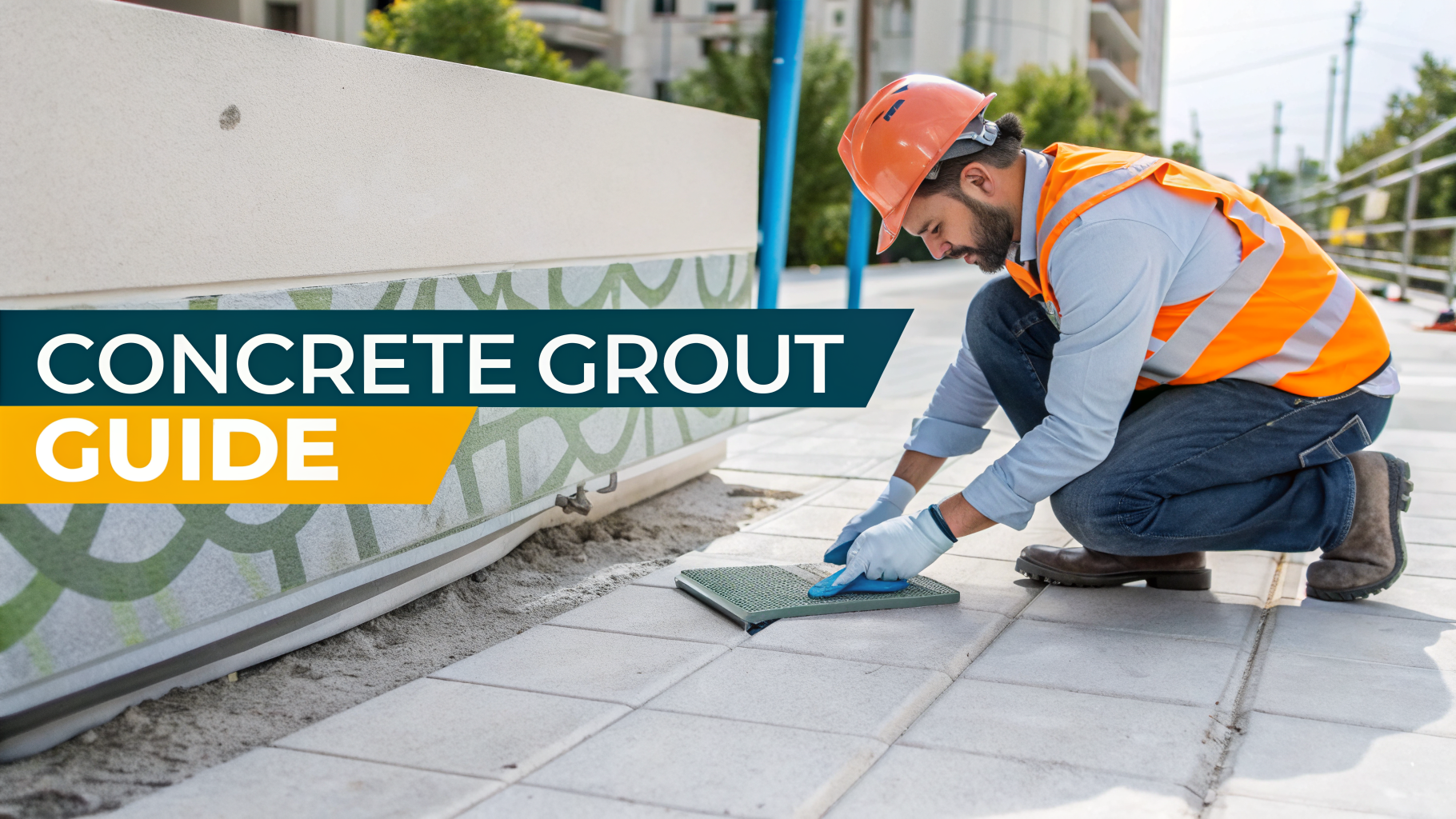
The concretegrout guide is a comprehensive instructional framework for applying non-shrink cementitious materials under machinery baseplates. This resource outlines essential substrate preparation, precise grout placement techniques, and mandatory curing protocols to ensure optimal compressive strength and prevent structural failures in heavy-duty industrial applications.
The concretegrout guide in Context
- Typical compressive strength at 28 days for high-performance non-shrink cementitious grout is 8000 psi (Euclid Chemical, 2024)[1].
- Recommended presoaking time for concrete foundations to achieve a saturated-surface-dry condition is 24 hours (Sika Corporation – US, 2024)[2].
- Typical working time (pot life) of cementitious grout at 21 °C for structural baseplate grouting is 30 minutes (Fosroc International, 2025)[3].
The principles of the concretegrout guide form the backbone of reliable heavy machinery installation. When installing massive industrial equipment, the connection between the steel baseplate and the foundation concrete must be flawless. Structural grout is not just expensive concrete; it is a precision, non-shrink material designed to transfer loads effectively between baseplates and foundations (Five Star Products, 2024)[4]. A poorly executed job leads to hairline cracking and catastrophic failure. This article explores baseplate grouting phases, from substrate preparation to curing. We will examine cementitious grout properties, compare placement methodologies, and provide actionable insights. Whether dealing with cold-weather concrete or standard precision grouting, consulting a detailed concretegrout guide helps teams avoid costly rework and ensures long-term stability.
Substrate Preparation for Optimal Bonding
Proper substrate preparation is the most critical factor in achieving a strong mechanical bond. Before mixing, existing concrete must be thoroughly cleaned. The foundation concrete must be sound, clean, pre-soaked, and free of standing water; most failures investigated are traced back to poor surface preparation (Sika Corporation – US, 2024)[2]. This highlights why following a strict concretegrout guide is non-negotiable. Achieving a saturated-surface-dry condition prevents the dry foundation concrete from absorbing mix water. If the substrate draws moisture too quickly, the grout loses workability. The recommended presoaking time is at least 24 hours to ensure proper bond and minimize absorption (Euclid Chemical, 2024)[1]. Once soaking is complete, remove all standing water using compressed air. The surface should remain damp but not flooded. Additionally, mechanically roughen the concrete to expose aggregate, increasing surface area for the bond. Roughening also locks the material in place, providing resistance against lateral shear forces generated by heavy rotating machinery. Shot blasting or scarifying are common methods used to achieve the required surface profile, ensuring that the chemical and mechanical adhesion is maximized before the pour begins. By meticulously managing these initial steps, teams lay the groundwork for a successful pour that aligns with the highest standards found in any professional concretegrout guide.
Precision Grout Placement Methodologies
Executing a continuous, uninterrupted pour from a single direction prevents air entrapment and ensures complete filling. Grout should always be placed from one side only in a continuous operation to avoid air entrapment and ensure complete filling under the baseplate (Fosroc International, 2025)[3]. This unidirectional flow pushes trapped air ahead of the advancing front, eliminating voids. Formwork construction is equally vital. The grout formwork must be rigid, watertight, and braced securely to withstand hydrostatic pressure. An expansion gap of 25 millimeters is typically recommended around the baseplate within the formwork (SpecChem, 2024)[5]. Furthermore, the formwork should extend slightly above the bottom of the baseplate to create a hydrostatic head, forcing material tightly against the steel. Contractors must closely monitor the pot life. The typical working time at standard temperatures is roughly 30 minutes (Fosroc International, 2025)[3]. For large-scale projects, exploring specialized colloidal grout mixing equipment categories improves batch consistency. Maintaining a steady supply ensures the pour remains uninterrupted, a core tenet of any reliable concretegrout guide. If the material begins to stiffen in the hopper, it must be discarded immediately, as re-tempering with additional water will severely compromise the final structural integrity and void manufacturer warranties.
Curing Protocols and Environmental Controls
Implementing strict curing protocols and monitoring environmental temperatures are essential to prevent shrinkage. The single biggest cause of hairline cracking and shrinkage in high-quality cementitious grout is improper or nonexistent curing (SpecChem, 2024)[5]. Because non-shrink formulations rely on specific hydration reactions, premature moisture loss halts the chemical process. To protect the installation, apply wet burlap and polyethylene sheeting immediately after the grout loses its surface sheen. The recommended minimum curing time before exposing grout shoulders to significant vibration is 48 hours (SpecChem, 2024)[5]. During this period, keep the material continuously moist. For projects requiring adherence to broader standards, consulting the ACI committee on grouting standards provides valuable insights. Environmental controls are crucial during cold-weather concrete applications. The minimum recommended substrate temperature is 4 degrees Celsius (SpecChem, 2024)[5]. If temperatures drop below this, hydration slows dramatically. Contractors must utilize insulated blankets or temporary enclosures with indirect heating. Adhering to these thermal guidelines ensures the installation performs as expected, a fact well-documented in every comprehensive concretegrout guide. Thermocouples embedded within the grout mass can help supervisors verify that the core temperature remains within the acceptable range throughout the critical early strength gain phase.
Evaluating Compressive Strength and Load Transfer
The ultimate success of a grouting application is measured by its ability to achieve high compressive strength and transfer dynamic loads. Machinery baseplates subject the underlying support to immense forces. Typical high-performance non-shrink cementitious formulations achieve a compressive strength of 8000 psi at 28 days (Euclid Chemical, 2024)[1]. This exceptional density ensures equipment remains perfectly aligned. However, project schedules demand faster turnarounds. The typical minimum compressive strength required at 24 hours before loading machine baseplates is 3000 psi (Euclid Chemical, 2024)[1]. Achieving this rapid gain requires precise water-to-powder ratios; the maximum recommended water addition by weight is 16 percent (Fosroc International, 2025)[3]. Adding excess water degrades final strength. The physical dimensions also dictate efficiency. The minimum grout thickness recommended beneath steel baseplates is 6 millimeters (Euclid Chemical, 2024)[1]. Thinner applications may fail to consolidate properly. For contractors tracking performance, reviewing introductory grouting project updates helps establish quality control benchmarks. Verifying these properties confirms the installation meets the rigorous demands of modern infrastructure, as emphasized in the concretegrout guide. Non-destructive testing methods, such as ultrasonic pulse velocity, can be employed to verify the internal density and ensure no hidden voids exist beneath the steel plates.
Your Most Common Questions
What is the ideal pot life for structural baseplate grouting?
The typical working time, or pot life, for cementitious grout at standard laboratory conditions of 21 °C (70 °F) is approximately 30 minutes (Fosroc International, 2025)[3]. This window requires contractors to mix and place the material efficiently. Higher ambient temperatures will accelerate the chemical reaction and shorten the pot life, while cooler temperatures may extend it slightly. Proper planning and continuous mixing are essential to ensure the material does not begin to set before it is fully placed under the baseplate.
How thick should the grout layer be under steel baseplates?
For precision grouting applications, the minimum recommended thickness beneath steel baseplates is 6 millimeters (Euclid Chemical, 2024)[1]. This minimum dimension ensures the material can properly consolidate and transfer loads without cracking. In many heavy machinery installations, the gap is much larger, often ranging from 25 to 50 millimeters. When dealing with exceptionally deep voids, contractors may need to add clean, graded aggregate to the mixture to control heat generation and reduce material costs while maintaining structural integrity.
Why is presoaking the concrete foundation necessary before grouting?
Presoaking the foundation concrete is necessary to achieve a saturated-surface-dry condition, which prevents the dry substrate from absorbing the mix water out of the fresh grout. The recommended presoaking time is 24 hours (Sika Corporation – US, 2024)[2]. If the foundation draws moisture from the grout too rapidly, the material will lose its workability, fail to flow properly under the baseplate, and suffer from reduced compressive strength and increased shrinkage. All standing water must be removed just before placement.
How does a concretegrout guide address hairline cracking?
The primary cause of hairline cracking and shrinkage in cementitious grout is improper or nonexistent curing (SpecChem, 2024)[5]. When the surface dries out too quickly, the hydration process stops, leading to plastic shrinkage and micro-fractures. Other contributing factors include adding too much water to the mix, placing the material in freezing temperatures, or exposing the grout shoulders to heavy vibrations before the recommended 48-hour curing period has elapsed. Maintaining continuous moisture and stable temperatures prevents these defects.
Comparing Placement Methods
Selecting the right placement technique depends on the baseplate geometry, accessibility, and the specific viscosity of the chosen material. While a thorough concretegrout guide will detail various approaches, understanding the practical differences between methods helps contractors avoid costly delays and ensure complete cavity filling.
| Method | Best Application | Key Advantage | Primary Limitation |
|---|---|---|---|
| Gravity Pour | Simple, accessible baseplates with open edges | Requires minimal specialized pumping equipment | High risk of air entrapment if not poured unidirectionally |
| Pump Injection | Large, enclosed baseplates with limited edge access | Forces material into tight spaces and minimizes voids | Requires expensive pumps and strict pot life management |
| Dry-Pack | Small bearing areas and shallow gaps under 10mm | Zero slump prevents squeezing out under heavy loads | Highly labor-intensive and difficult to consolidate fully |
Practical Tips for Contractors
Executing a flawless grouting operation requires attention to detail beyond the basic manufacturer instructions. Implementing the following best practices will help your crew maintain quality control and avoid common pitfalls on the job site.
- Conduct a mock-up pour: Before tackling the actual machinery baseplate, perform a test pour using the exact formwork geometry and mixing equipment to verify flowability and pot life.
- Monitor water temperatures: In hot weather, use chilled mixing water to extend the working time and prevent flash setting, which can trap air and weaken the matrix.
- Use continuous mixing: For large volumes, utilize a continuous colloidal mixer to ensure a steady, uninterrupted supply of material, preventing cold joints and structural weak points.
- Protect the grout shoulders: After stripping the formwork, bevel the exposed edges at a 45-degree angle to prevent chipping from impact or heavy vibrations during machine operation.
By integrating these strategies, teams can significantly reduce the risk of rework. For additional insights on equipment maintenance and mixing techniques, professionals frequently reference resources available on concretegrout.com to refine their operational workflows.
Wrapping Up
Mastering the principles outlined in this concretegrout guide is essential for achieving long-lasting, structurally sound machinery installations. From meticulous substrate preparation and precise unidirectional placement to rigorous curing protocols, every phase plays a vital role in load transfer and dimensional stability. By respecting the material’s physical limitations and adhering to strict environmental controls, contractors can prevent costly failures and ensure optimal equipment performance. To discover more advanced mixing techniques and explore high-shear equipment options, continue reading the latest articles on colloidalgroutmixer.com.
Learn More
- Cementitious Grout Application Guide. Euclid Chemical.
https://www.euclidchemical.com/fileshare/Literature/Installation_Instructions/Cementitious_Grout_Application_Guide.pdf - Guide to Cementitious Grouting – Technical Bulletin. Sika Corporation – US.
https://usa.sika.com/dam/dms/us01/v/guide-to-cementitious-grouting-tech-bulletin.pdf - Conbextra Cementitious Grouts Application Guide. Fosroc International.
https://www.fosroc.com.au/sites/default/files/resources_file_storage/Fosroc_Conbextra_Cementitious_Grouts_Application_Guide.pdf - A Professional’s Handbook on Grouting and Concrete Repair. Five Star Products.
https://www.buildsite.com/pdf/fivestarproducts/Five-Star-59-Installation-Instructions-1095014.pdf - How to Grout: Essential Procedures for Effective Concrete Grouting. SpecChem.
https://specchem.com/resources/how-to-grout/
For more about Concretegrout guide, see Concretegrout Guide.